“You can’t fix a narrative with more of the same narratives.”
–Rev. Dr. Soong-Chan Rah
Amidst a centrifugal effort to encourage celebration of our nation’s 250th anniversary, as witnessed in television ads and disorienting public displays of patriotism blended with Christian worship and prayer, even as communities decry the loss of voting rights and the unraveling of landmark Civil Rights victories, I’ve found myself asking, What’s our relationship with lament on this side of Easter?
This question spiked again on a recent visit to the site of a World War II era internment camp here in Washington State.
Standing shoulder to shoulder with a group of pastors in Puyallup, I peered into an 8-foot by 10-foot historic recreation of an internment barrack. Gaps between the boards making up the walls were clearly visible. Narrow beds sat beside a small stove with a chimney rising up to the ceiling. Clothes hung on walls. No source of running water. A single window. A figure huddled beneath a blanket in the corner of the room.
Our tour guide explained that these internment barracks were converted horse stalls, directly beneath the state fairground grandstands. The constrained spaces became makeshift homes for entire families, representing more than 7,000 Japanese and Japanese-Americans here in the Puget Sound area.
With just a few days’ notice in March of 1942, following President Franklin D. Roosevelt’s Executive Order 9066 a month earlier, thousands of families were forcibly removed from their homes and incarcerated in “camps” throughout the U.S.: Washington State, Montana, California, Idaho, Arizona, Utah, and even Arkansas.
The young and adult alike could not have imagined when they arrived that this would be their home for more than three years.
When I first learned of the internment camps built just miles from my home, I was visiting Bainbridge Island—less than a 30-minute ferry ride from downtown Seattle. Black and white photos caught my eye while visiting a Bainbridge Island restaurant, displaying scenes of families being led from the island. The scenes were jarring in their revelation. Bainbridge was the first community in the United States where local residents were forcibly removed from their homes.
On March 30, 1942, 227 Bainbridge Island residents were led by force from their community and sent to faraway internment camps, first in California and later in Idaho. In the days that followed, this experience was repeated for 120,000 people—two thirds of whom were American citizens. This local history was missing from my education for the first 30 years of my life. I’m certainly not alone in not knowing about the proximity of this painful history.
“In the United States, grief and pain related to race are often suppressed,” Soong-Chan Rah writes in Prophetic Lament, a book our Mosaic pastors cohort has been reading. “And the stories of suffering are often untold.”
One reason for this gap in our national memory, Rah notes, is America’s valorization of and commitment to triumphalism and exceptionalism. Accounts of concentration camps built and maintained on U.S. soil, and the tragic treatment of those forced to make a home within them, contradict our self-constructed image: a beacon of liberty to the world. These are precisely the kind of stories that are actively removed and hidden from public consciousness.
“We are presented with triumphalistic narratives that minimize stories of struggle. Our historical reflection reveals an obsession with success and celebration while stories of survival and suffering are ignored.”
This tendency is even more pressing in the years since Prophetic Lament was first written. Today, public memorials detailing our nation’s history of slavery, racial violence, wrongful incarceration, and more are being systematically removed from public spaces, following a directive from President Trump, in an effort to avoid any accounts that threaten to “disparage Americans.” These public memorials are being replaced and rewritten with narratives that offer a more positive view of the United States and its history.
Sadly, the Church in North America is not immune to such efforts. Without reducing or flattening ecclesial differences, one subtle way this happens in our Christian imagination and life together is in our worship liturgy.
Soong-Chan Rah’s Prophetic Lament details the tendency to forego liturgies of lament for liturgies of celebration. In place of songs and scripture readings that give space for the discomfort of death, violence, and grief, often we choose the easy comforts of songs and scriptures of praise. The result of such choices is an amnesiac body that distances itself from struggles and suffering—our own and our neighbors’.
“The absence of lament in the liturgy of the American church results in the loss of memory…we forget the reality of suffering and pain.”
The relationship between avoiding lament and a loss of memory feels especially true when it comes to our public relationship with our national history, as well as our ongoing legacies of racial discrimination and violence.
“As we rush toward a description of an America that is now postracial,” Rah writes, “we forget that the road to this phase is littered with dead bodies. There has been a deep and tragic loss in the American story because we have not acknowledged the reality of death.”
My experience visiting the internment camps here in Washington State came from an invitation from the Olympia Presbytery. Led by Telos’ partner organization Arrabon, I was grateful to join the group’s anti-racism training, and to learn more about the history of race-based internment camps built a couple hours’ drive from where I grew up, and an even shorter distance from where I live today. And, I was encouraged to see so many pastors taking the time to understand this local history, hidden in plain sight.
“The knowledge of this history,” Rah notes, “can begin the process toward an authentic lament.”
Gathered with a group of pastors from the Olympia Presbytery on a sunny Thursday in early spring, our tour guide at the Puyallup Valley Chapter of the Japanese American Citizens League (JACL) explained that the Puyallup Fairgrounds was one of 17 makeshift concentration camps built by the U.S. Army as a result of Executive Order 9066.
Growing up, I had assumed, likely because I had been told, that those who were held in U.S. camps were detained for national security. Certainly that must have been the public narrative at the time. The Puyallup Remembrance Gallery tells a more complicated story.
“America’s long-simmering racist ideologies—reinforced [not created] by the attack on Pearl Harbor, Hawaii—paved the way for mass removal and incarceration,” one placard reads.
Racist language and beliefs, not war, created the necessary conditions for forced removals and the incarceration of 120,000 people in internment camps throughout the U.S.
Large placards that hang on the Puyallup Remembrance Gallery’s walls detail the experiences of the more than 7,500 Japanese and Japanese Americans from Alaska, Seattle, and rural towns of Pierce County who were imprisoned here, in these former animal stalls. They were later moved inland to one of 10 permanent concentration camps. These makeshift communities were hurriedly built, lacking proper insulation, as well as basic amenities such as partitions between toilets, drainage for sewage, or adequate food.
Families who lived in these camps were given wartime rations, our tour guide explained. Given the timing, I assumed she was referring to World War II military rations. She was not. The meals were left over from the so-called “Great War,” more than two decades earlier. Terrible sickness spread among the interred communities. Groups of interred people rushed to the communal restrooms in the dark of night, only to be stopped at gunpoint by guards who were concerned they were trying to escape.
These are the devastating stories that took place within driving distance of where we were raised, went to school, graduated, and got our first jobs. These are the tragic stories that are often hidden in plain sight.
“Lament is denied because the dead body in front of us is being denied.”
At the heart of the Puyallup Remembrance Gallery is a wall lined with floor-to-ceiling columns of names of the more than 7,500 people who were imprisoned at the fairgrounds, each name assigned a number:
Fujino (10920). Fujioka (10840). Fujita (11292)…
Goto (10922). Habu (11750). Hachiya (16602)…
Imanaka (43094). Imanishi 17547). Imasato (12197)…
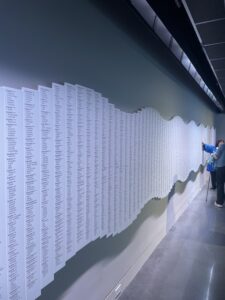
In a society that actively denies and intentionally hides its grief, creating a deathly distance between ourselves and our neighbors, physical memorials like this one, which offer an invitation to lament, serve as the antidote. Such public memorials hold the capacity to help us move forward in a responsible, faithful way.
“Lament,” Rah reminds readers, “is honesty before God and each other…Lament recognizes the struggles of life and cries out for justice against existing injustices.”
The phrase Nidoto nai yoni is printed on walls and signage throughout the Puyallup Remembrance Gallery: “Let it not happen again.”
Much as we resist the challenging experiences of honestly sitting with our national and local grief, both historical and contemporary, this kind of honesty allows us to begin the work of peacemaking and reconciliation.
As Christians, we are as guilty of avoiding the discomfort of lament as anyone. And yet, we know that the path of reconciliation inaugurated by the Easter event requires a journey through the painful reality of Good Friday. We cannot have one without the other.
Equal Justice Initiative Founder and Executive Director Bryan Stevenson underlined this point in a recent episode of NPR’s Fresh Air: “You can’t get the beautiful ‘R’ words, like redemption and reconciliation and restoration and repair, unless you first tell the truth.”
Stevenson goes on to explain the unique voice the Church offers for such truth-telling work.
“At least in my church you can’t come in and say, ‘I want heaven and salvation and all the good stuff, but I’m not going to confess anything.’ The clergy at least in my community will say, ‘Oh no, it doesn’t work like that.You gotta be willing to repent. You gotta be willing to confess.’”
Painful though it may be, this liturgical invitation to confession and repentance is not to be understood as punishment, but the necessary path to healing.
“But then they’ll say, ‘Don’t fear it! Because repentance and confession, acknowledgment is what opens up your heart to grace and mercy. And grace and mercy is what yields redemption and reconciliation and restoration.’”
The transformation that Christian leaders are both offered by God in Christ and called to embody and offer their communities requires truth telling. This kind of truth telling is a critical role faith communities can continue to offer their local, regional, and even national communities. The kind of truth telling that ultimately means our freedom and our peace.
“To speak a true word,” Paulo Freire wrote in Pedagogy of the Oppressed, “is to transform the world.”
In our work at Telos with churches across the country, I’ve been encouraged to hear about local pilgrimages being offered to congregations. South Bend City Church offers a neighborhood immersion pilgrimage for congregants, introducing them to the complex history of its city, the unjust structures that continue to operate, and to community leaders who are creatively working together to shape a healed and healing culture.
Earlier this year, Denver Community Church launched a similar multi-week peacemaking learning experience: Peacemaking Praxis. The class concludes with a weekend-long local pilgrimage, introducing congregants to community leaders and business owners from historically marginalized populations who are actively working to address the city’s most pressing needs.
And since 2019, Castle Church in Norwich, Connecticut has been working on Project Jubilee. The first phase of this project involved revitalizing a community park and creating beautiful and compelling murals that celebrate Sarah Harris Fayerweather and James Lindsey Smith, Black community leaders who have shaped the Norwich community and beyond in powerful ways. The mural has become a site for the city’s Juneteenth celebration, creatively supporting local efforts for healing and reconciliation along racial divides.
These and other church-led projects represent an effort to tell the truth about our local context and our relationships therein, in a way that is rooted in the truth-telling work of the gospel.
Telling the truth about how God raised Jesus from the grave after the Empire of Rome wrongly incarcerated and executed Jesus of Nazareth transformed not only the individuals who heard this account, it powerfully confronted and even overturned corrupt socio-political structures of their day and, indeed, the wider world.
Offering the kind of honesty that transforms the world by countering the narratives of our day is one way Christians can continue to participate in the transformative work of Resurrection on this side of Easter.
Early last month, Soong-Chan Rah joined our monthly Mosaic pastors cohort for a virtual seminar. Speaking on the topic of lament, his reference to the power of narrative and counternarratives has stayed most with me.
“You can’t fix a narrative with more of the same narratives,” Soong-Chan Rah said, pausing, before repeating the line. “You can’t fix a narrative with more of the same narratives.”
Resources:
- Prophetic Lament: A Call for Justice in Troubled Times, Soong-Chan Rah
- Pedagogy of the Oppressed, Paulo Freire
- “Bryan Stevenson says facing our racist past is a path, not punishment,” March 25, 2026, by Terry Gross, Tonya Mosley, and Adam Staniszewski
Photos: Ryan Pemberton via the Puyallup Valley Chapter of the Japanese American Citizens League